

AI差旅报销 is a workflow where small delays compound. A missing receipt on Friday can delay a reimbursement by two weeks, and a claim that ignores the policy limit comes back with a comment that costs another day. The goal is a first submission that needs no conversation.
This guide covers the five-step process we use, the fields finance checks first, and the habits that keep a claim clean while traveling.
Key Takeaways
- Capture receipts the same day.
- Check the limit for the city and role.
- Separate transport, lodging, and meals.
- Explain every exception in one line.
- Submit by period, not by memory.
Why AI差旅报销 Should Start During the Trip
Most claim problems are created by delay. Receipts fade, paper gets lost, and the purpose of a payment becomes unclear a month later. AI差旅报销 can extract the details from a photo, but it cannot recover a receipt that was never taken.
A daily two-minute habit solves most of the problem. Photograph the receipt, note the purpose, and move on. When the trip ends, the claim is already assembled. AI差旅报销 then checks the fields and flags the exceptions instead of building the record from scratch.
The second reason is policy awareness. Limits vary by city and role, and they change. A claim tool that checks against current rules prevents the awkward conversation about a hotel that was slightly over budget.
How AI差旅报销 Works in Five Steps
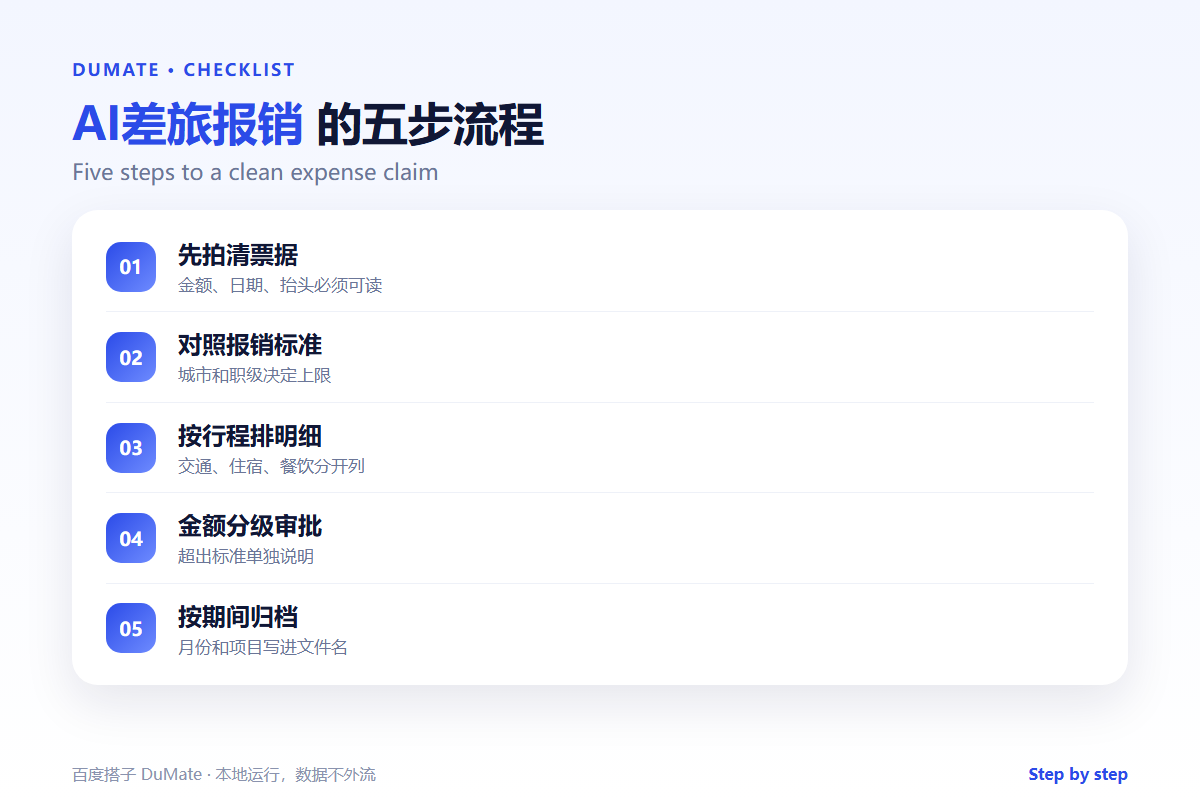
Step 1: Capture every receipt
Photograph the full receipt, including the merchant name, date, amount, and tax. Keep the payment method visible if your policy requires it. A clear photo is the difference between automatic extraction and manual entry.
Step 2: Record the business purpose
Write one line: client meeting in Shanghai, supplier audit, or training in Shenzhen. The purpose is the field most often missing, and it is the first thing a reviewer asks about.
Step 3: Check the policy limit
Compare each expense with the limit for that city and role. If an exception was necessary, explain it in one sentence and attach the approval if you have it. AI差旅报销 can flag the exception before submission.
Step 4: Group by category and date
Separate transport, lodging, meals, and other costs. Sort by date within each category. Reviewers can then check the trip chronologically instead of deciphering a mixed list.
Step 5: Submit and archive
Submit the claim with all attachments, then save a copy for your records. AI差旅报销 should produce a summary that matches the finance system, so the reviewer does not have to reconcile two versions.
What Finance Checks First
- Receipt matches the claimed amount.
- Date falls within the trip window.
- City and role limit respected.
- Business purpose is specific.
- Approval exists for exceptions.
Where AI差旅报销 Fails
It fails when receipts are photographed in poor light or with the total cut off. It also fails when personal expenses are mixed into the claim, which forces a manual separation. Finally, it fails when the claim is submitted without checking the current policy, which may have changed since the last trip.
- Blurry or partial receipt images.
- Missing business purpose.
- Currency conversion without a rate note.
- Personal costs included by mistake.
Before and After
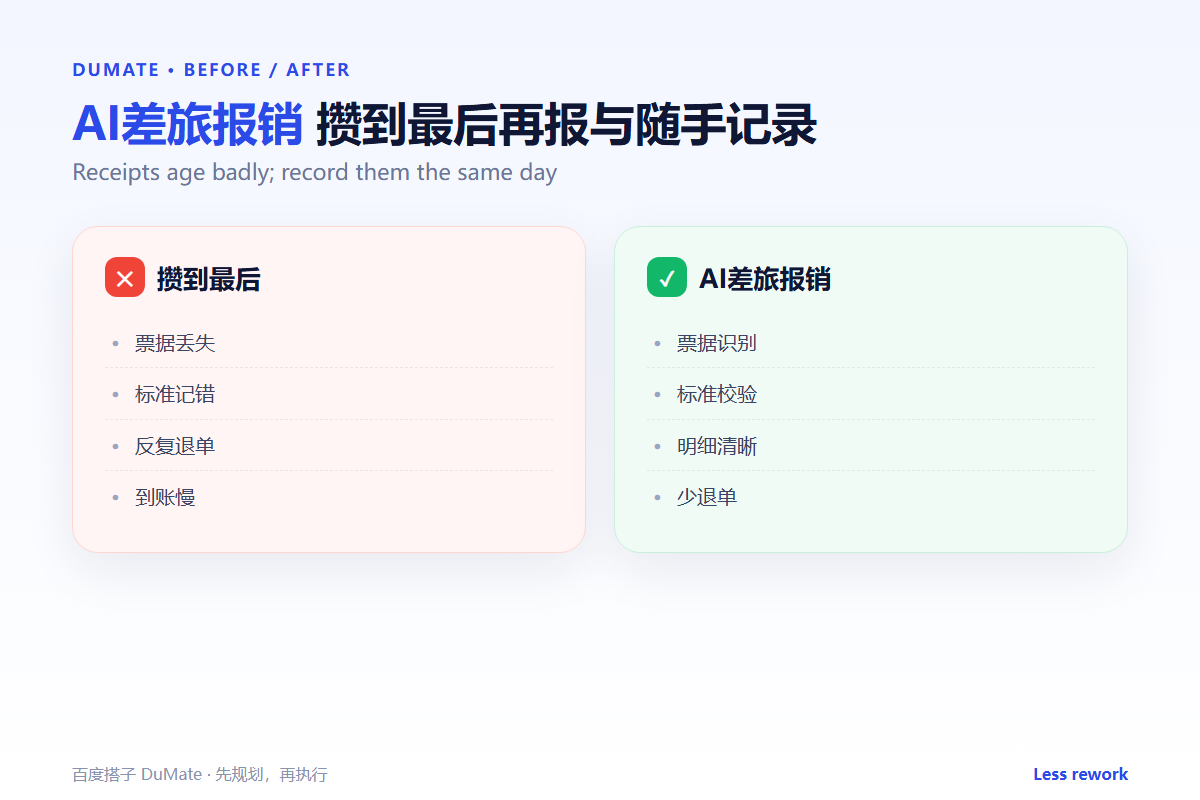
Before, a traveler spent two hours reconstructing a trip from a shoe box of receipts, and finance sent it back twice. After, receipts are captured daily, AI差旅报销 checks the limits, and the claim is submitted the day after the trip. The reimbursement arrives a week earlier.
The process also improves the relationship with finance. A clean claim is a sign of respect for the reviewer’s time, and it makes exceptions easier to discuss when they are genuinely necessary.
Keep a short personal template for recurring trips. The same categories, the same note format, and the same folder structure make each claim faster than the last. AI差旅报销 turns that consistency into a few minutes of review instead of an afternoon of typing.
Finally, review your own exceptions each quarter. If the same category is always over the limit, the issue may be the policy or the trip pattern, not the claim.
Keep a photo of the claim summary before submitting. If the system loses an attachment, the summary shows what was sent and when. That small record prevents the most frustrating kind of delay, where the traveler and finance disagree about what was uploaded. A careful AI差旅报销 process is not only about speed; it is about being able to prove what happened.
At the end of each trip, compare the claim with the original plan. If the same category is always over budget, adjust the plan rather than the claim. That habit makes AI差旅报销 more accurate over time, and it gives finance a clearer picture of real travel costs instead of a series of exceptions. Over a year, that clarity improves both the AI差旅报销 process and the travel plan itself.
FAQ
What if a receipt is lost?
Follow your company’s exception process and attach a written explanation. Do not substitute a different receipt.
Can AI差旅报销 handle foreign currency?
Yes, but record the exchange rate and the date used. Reviewers need to see how the amount was converted.
How soon should we submit?
Within a week of returning. Memory fades quickly, and the finance system may have a submission deadline.
延伸阅读
Receipt extraction is covered in AI发票识别. Reconcile the claim table with AI表格处理. Send the summary with AI邮件助手. Access and approval rules are in AI权限管理. Clean the data before analysis with AI数据清洗. External references: NIST AI Risk Management Framework and ISO/IEC 42001.
评论
还没有评论,来说两句吧。