
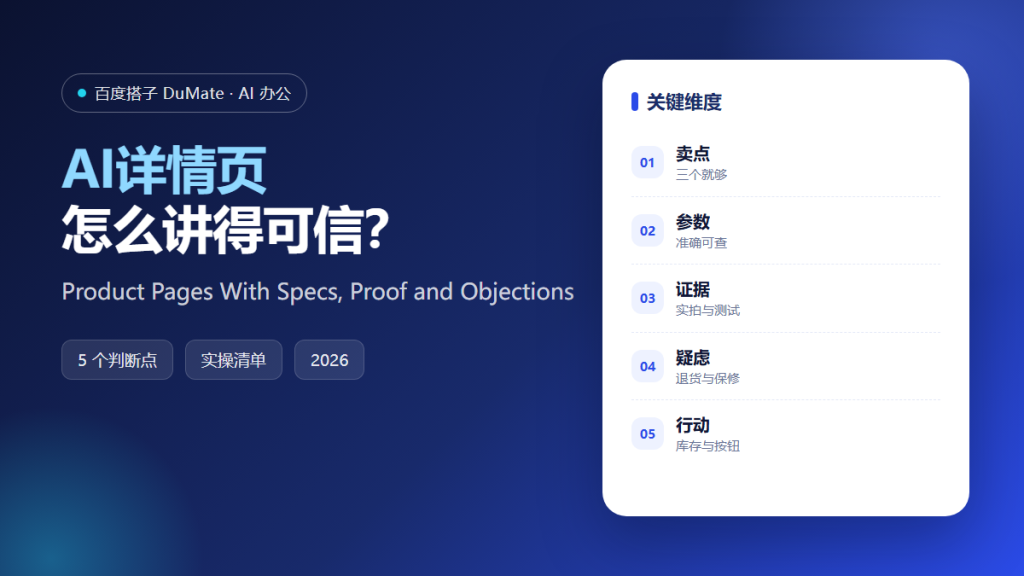
AI详情页 has one job that outweighs design: give a ready buyer every fact needed to say yes without opening a chat window. A beautiful page that omits the dimensions, the material, or the return window sends the buyer to a competitor who wrote them down. Detail is the conversion feature, and it belongs above the fold.
This guide covers spec order, proof placement, and the five-step routine that turns a product page into a decision aid. It also covers the three objections that appear on almost every category page.
Key Takeaways
- List the specs that decide the purchase.
- Order them by the question the buyer asks first.
- Put proof beside the claim it supports.
- Answer three objections in the flow.
- Check the page on a phone before launch.
Why AI详情页 Needs Specs and Proof
A buyer who has decided to purchase is looking for permission, and permission comes from specifics. The weight, the dimensions, the material, the compatibility, and the care instructions are not decoration; they are the difference between a cart and a return. AI详情页 should treat the specification as the main argument and the photography as its evidence. A page that hides a limitation loses the sale later, in the return request.
Proof works when it sits next to the claim. A sentence about durability followed by a test result, a warranty term, and a dated review is more convincing than the same three items in a separate tab. AI详情页 should arrange the page so the reader never has to hold a claim in mind while scrolling for support.
Objections deserve the same treatment. Every category has three recurring doubts, and they are usually about fit, quality, and what happens after the sale. AI详情页 that answers them inside the flow keeps the buyer in the page, while a page that hides the answers in an FAQ teaches the buyer to open a new tab.
How AI详情页 Works in Five Steps
Step 1: Collect the deciding specs
Read the questions customers ask before buying and the complaints they raise after. The first list gives the specs to add, and the second gives the specs to correct. Keep the units, the tolerances, and the conditions, because a number without a condition is only half a fact. A support transcript is often more honest than a specification sheet.
Step 2: Order by the buying question
Put the spec that decides the purchase first, then the ones that confirm it. A buyer choosing a replacement part needs compatibility before color; a buyer choosing a gift needs size and delivery first. The order should follow the conversation, not the internal data sheet.
Step 3: Place proof beside each claim
Match every strong claim with evidence within the same screen: a test report, a warranty, a measured photo, or a dated review. Remove claims that cannot be supported. A page with fewer promises and better evidence reads as more confident, not less.
Step 4: Let AI详情页 answer three objections
Choose the three doubts that appear most often in chats and returns, and answer each in one short block near the relevant spec. AI详情页 can draft the wording from real questions, but a person should confirm the facts and the tone before publishing.
Step 5: Check the page on a phone
Open the page on a mid-range phone and try to find the size, the price, and the delivery date within ten seconds. If any of them requires pinch or scroll, the layout is hiding the answer. Test the gallery, the variant selector, and the buy button in the same session.
‘ alt=’AI详情页 checklist: deciding spec, proof and three objections’ />
A Detail Page Checklist
- The deciding spec appears above the gallery.
- Every claim has evidence within one screen.
- Fit, quality, and after-sale doubts are answered.
- Units, conditions, and compatibility are explicit.
- The buy button works on a phone.
Where AI详情页 Fails
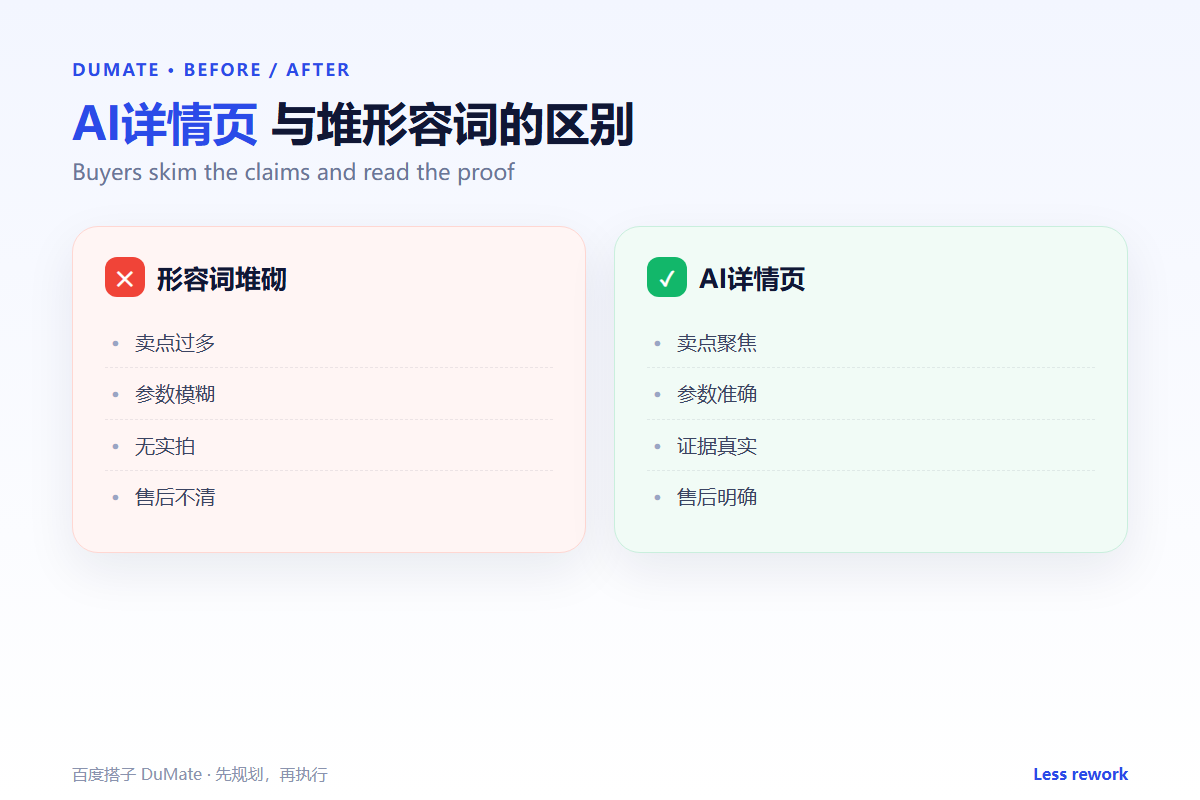
AI详情页 fails when the page copies the manufacturer’s sheet. A list of parameters without context answers a question the buyer did not ask, and the missing context becomes a support ticket after the sale. AI详情页 built from an internal template repeats the same gap across a whole catalog.
- Specs without units or conditions.
- Photos that hide scale and texture.
- An FAQ that repeats the marketing copy.
- Claims with no test, date, or source.
Before and After
Before, a page listed twenty parameters in a table at the bottom, with a gallery that made a small item look large. Buyers ordered the wrong variant, and returns climbed. After, AI详情页 was rebuilt with compatibility first, a measured photo beside the size, and three answers taken from support transcripts.
The traffic did not change. Returns fell within a month, and the support team answered fewer questions that the page could have answered itself.
FAQ
How many specs are too many?
When the reader cannot find the one that matters. Keep the deciding set prominent and move the rest to a collapsed table for the few who need it. AI详情页 should favor the buyer’s question over the complete table.
Do reviews count as proof?
Yes, when they are dated and specific. A review that mentions a use case is stronger than a star average, and AI详情页 should quote the sentence rather than the score.
Should we show the price on the page?
Yes, if the buyer can purchase without a call. A range is acceptable when variants differ, as long as the difference is explained next to the number.
延伸阅读
For the images that carry the detail, see product image, and for the wording around them, product copy. Errors that damage trust are listed in typo check. Paid traffic lands here from ad copy, and behavior can be reviewed in log analysis. External references: NIST AI Risk Management Framework and ISO/IEC 42001.
评论
还没有评论,来说两句吧。