
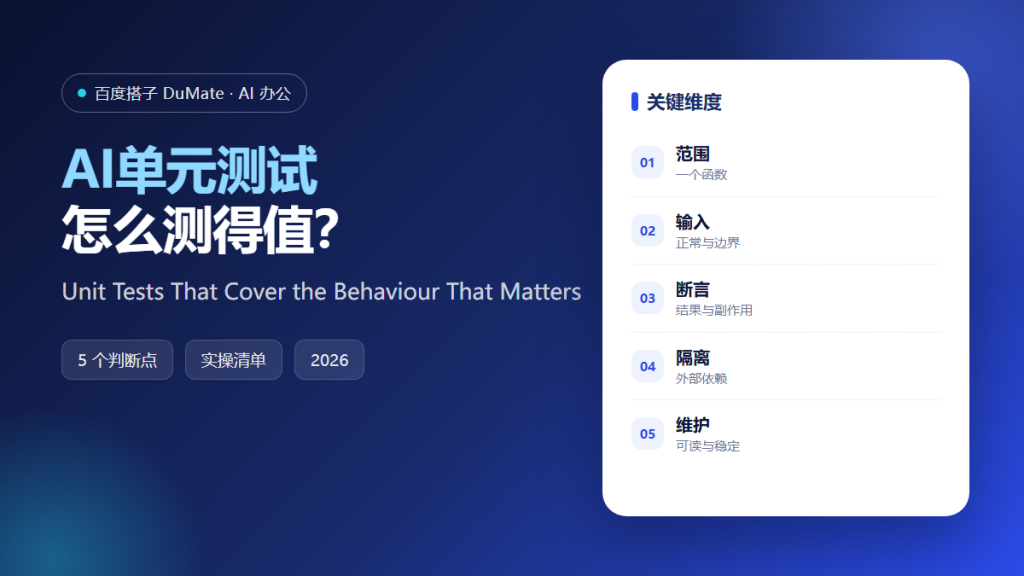
AI单元测试 is valuable when it covers the behaviour that would hurt to break, not when it inflates a coverage number. A suite of a thousand assertions on getters feels productive and protects almost nothing. The question to ask is simple: which mistake would reach a user, and does a test catch it?
This guide explains how AI单元测试 fits a development loop, the five steps from a behaviour list to a fast suite, and the patterns that make tests expensive to keep. The goal is a suite that earns its runtime and tells the truth when it fails.
Key Takeaways
- Start from behaviours, not from files.
- Test boundaries and failure paths.
- Write the failing test before the fix.
- Mock the edge of the system, not its core.
- Keep the suite fast enough to run often.
Why AI单元测试 Needs a Behaviour List
Coverage measures lines executed, not decisions protected. A function can reach every line and still mishandle an empty list. AI单元测试 is useful when it starts from a short list of behaviours written in business language and then maps each one to a test that a non-programmer could understand. A short list also gives the team a shared vocabulary for bugs.
The second reason is regression. A test earns its place when it fails for a reason a user would notice. AI单元测试 should name the scenario and the expected result, so a failure report reads like a bug rather than a stack trace, and the person on call knows where to look first.
The third reason is speed. A slow suite is run once a day, and a suite run once a day stops being a safety net. AI单元测试 should keep each case small, isolate the clock and the network, and leave integration checks to a separate stage that can afford to be slower.
How AI单元测试 Works in Five Steps
Step 1: List the behaviours
Write five to ten sentences describing what the unit must do, including what it must refuse. Mark the ones that carry money, permissions, or data loss. AI单元测试 should generate candidates, but the team ranks them by consequence rather than by ease. Keep the list next to the module, not in a separate wiki that nobody updates.
Step 2: Pick the boundaries
Choose values at the edge: zero, one, the maximum, an empty string, a duplicate. Add one realistic case in the middle. AI单元测试 often overproduces happy paths and underproduces the edges that cause incidents, so review the list before writing code. Write down why each boundary matters, not only the value.
Step 3: Write the failing test
Run it and confirm it fails for the expected reason. A test that passes before the change proves nothing. AI单元测试 can draft the assertion; the developer confirms that the failure message is readable and points at the behaviour rather than at a line number.
Step 4: Implement the smallest change
Make the test pass without adding unrelated behaviour. If the fix requires a redesign, stop and update the behaviour list first. AI单元测试 is a design prompt as much as a verification tool, and the pause often reveals a simpler shape.
Step 5: Keep the suite fast
Measure the runtime and remove cases that duplicate each other. Replace sleeps with controlled clocks. AI单元测试 should leave the suite quick enough that a developer runs it before every commit, because a suite that is skipped protects nothing. Measure it on the slowest laptop the team uses, not the fastest.
‘ alt=’AI单元测试 checklist: behaviours, boundaries, failing test and speed’ />
A Unit Test Checklist
- Each test names one behaviour.
- Boundary values are covered.
- At least one failure path is asserted.
- The test fails for the right reason first.
- The full suite runs in seconds.
Where AI单元测试 Fails
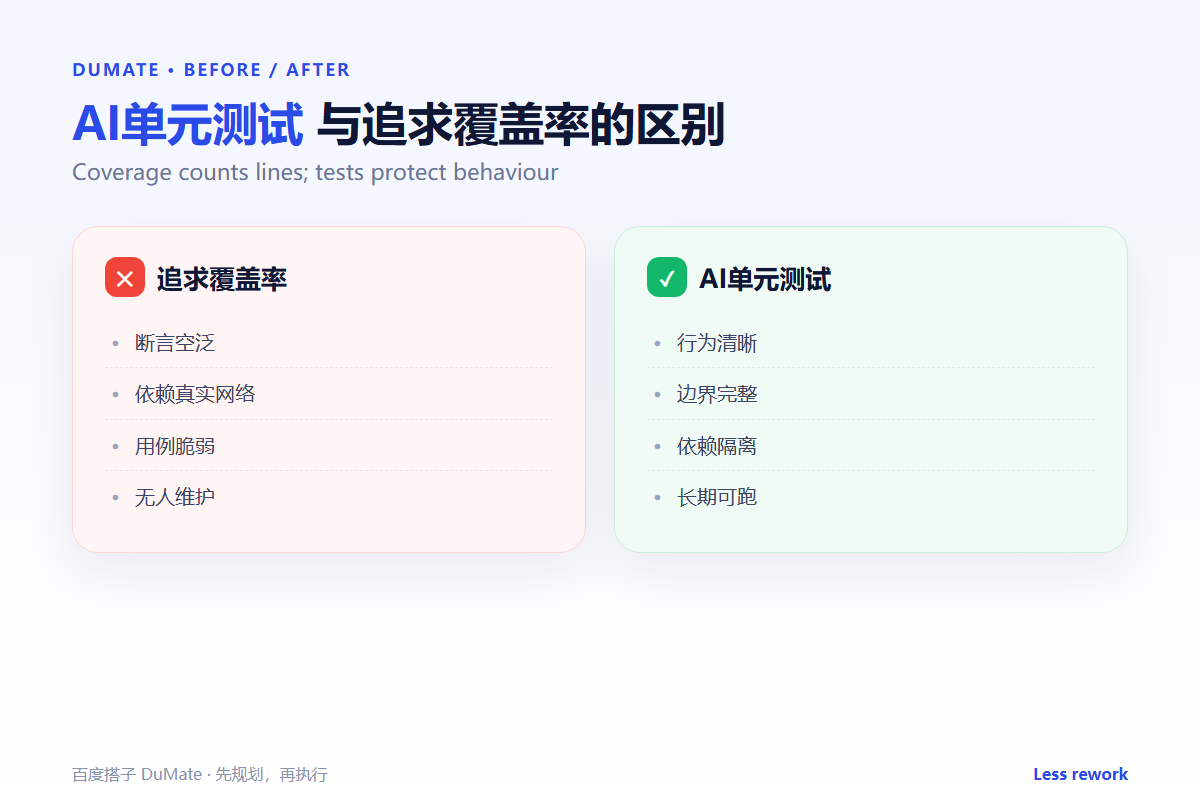
It fails when tests mirror the implementation, so a refactor breaks twenty cases without changing behaviour. It also fails when mocks are so detailed that the test verifies the mock rather than the code. In both cases the suite looks strong and slows every future change. The suite grows, the feedback slows, and people start to skip it on a busy afternoon. A test that has never caught a defect and duplicates another is a cost, not a safeguard.
- Assertions on private methods.
- Sleep-based timing assumptions.
- No assertion, only execution.
- Shared state between tests.
Before and After
Before, a billing module had eighty percent coverage and no test for a zero-amount invoice. The bug reached production, and the suite stayed green throughout, which taught the team to distrust the number on the dashboard. The team had measured activity rather than protection.
After, AI单元测试 started from a behaviour list that included zero, negative, and duplicate charges. Coverage dropped slightly, the suite ran faster, and the next release shipped without a billing patch. The team also stopped counting assertions and started counting behaviours that a user would notice. That shift changed which tests were written first.
FAQ
What coverage target should we use?
Use coverage as a warning, not a goal. A useful target is every behaviour on the list, with particular attention to money, access, and data changes that cannot be undone.
Does AI单元测试 replace integration tests?
No. Unit tests protect logic; integration tests protect contracts between systems. Keep both, and keep them separate so a failure points to the right layer.
How do we test legacy code?
Start with a characterisation test around the current behaviour, then improve the design. AI单元测试 can capture the existing output before anyone edits the function, which makes the first refactor safe. Keep the captured output as a baseline and change it only with a review.
延伸阅读
Design cases with test cases, reuse practice items from question bank, and organise fixtures with data labeling. Runtime evidence lives in log analysis, and clearer reports in document proofreading. External references: NIST AI Risk Management Framework and ISO/IEC 42001.
评论
还没有评论,来说两句吧。