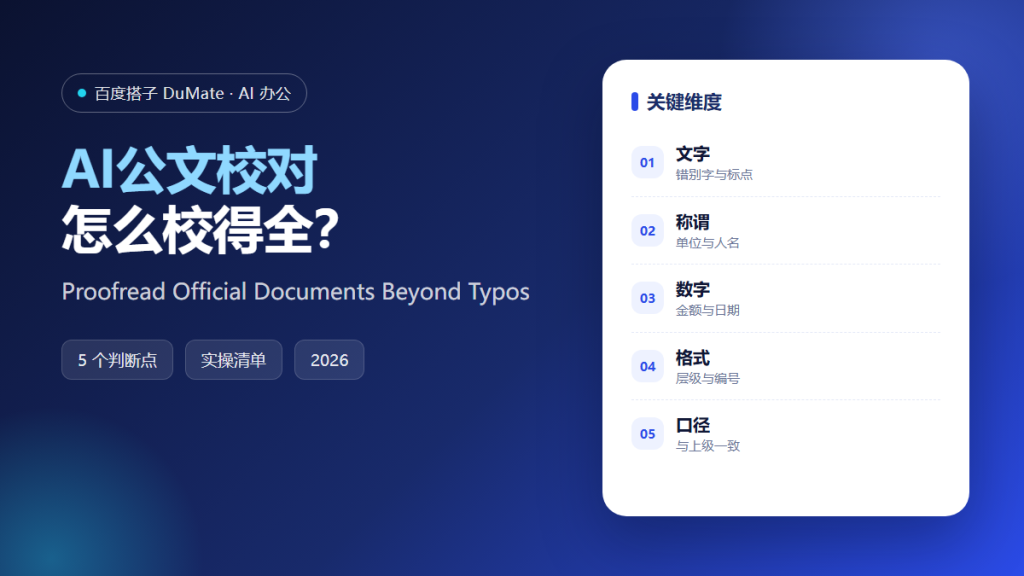
AI公文校对 is often treated as a spelling check. That catches the least damaging errors. The errors that cause real trouble are a wrong title, an inconsistent figure, or a numbering scheme that breaks in the middle of a document.
This guide covers a five-pass proofreading method, the items that must be checked against the source, and the final read that catches what the tool misses.
Key Takeaways
- Read once for meaning before checking words.
- Verify titles, names, and ranks.
- Cross-check every number and date.
- Review the numbering and hierarchy.
- Align wording with the superior document.
Why AI公文校对 Needs Multiple Passes
Different errors require different attention. Reading for meaning is incompatible with checking punctuation, and checking numbers is incompatible with checking style. A single pass produces a false sense of completeness.
The second reason is source alignment. Official documents often quote a higher-level document. AI公文校对 should compare the quoted wording with the source, because a small change can alter the obligation.
How AI公文校对 Works in Five Steps
Step 1: Read for meaning
Read the document once without a pen. Confirm the purpose, the audience, and the required action. AI公文校对 should not begin until this is clear.
Step 2: Check words and punctuation
Run a tool, then read again. Pay attention to Chinese and English punctuation, spacing, and full-width characters. AI公文校对 catches many of these, but not all.
Step 3: Verify titles and names
Check organization names, department names, job titles, and personal names. These are high-visibility errors. AI公文校对 should be given an approved list.
Step 4: Cross-check numbers
Compare amounts, percentages, dates, and counts across the text, tables, and attachments. One number in two places must match. AI公文校对 can flag differences.
Step 5: Check structure and alignment
Review the heading levels, numbering, and paragraph order. Compare key phrases with the superior document. AI公文校对 should report any deviation for a human decision.
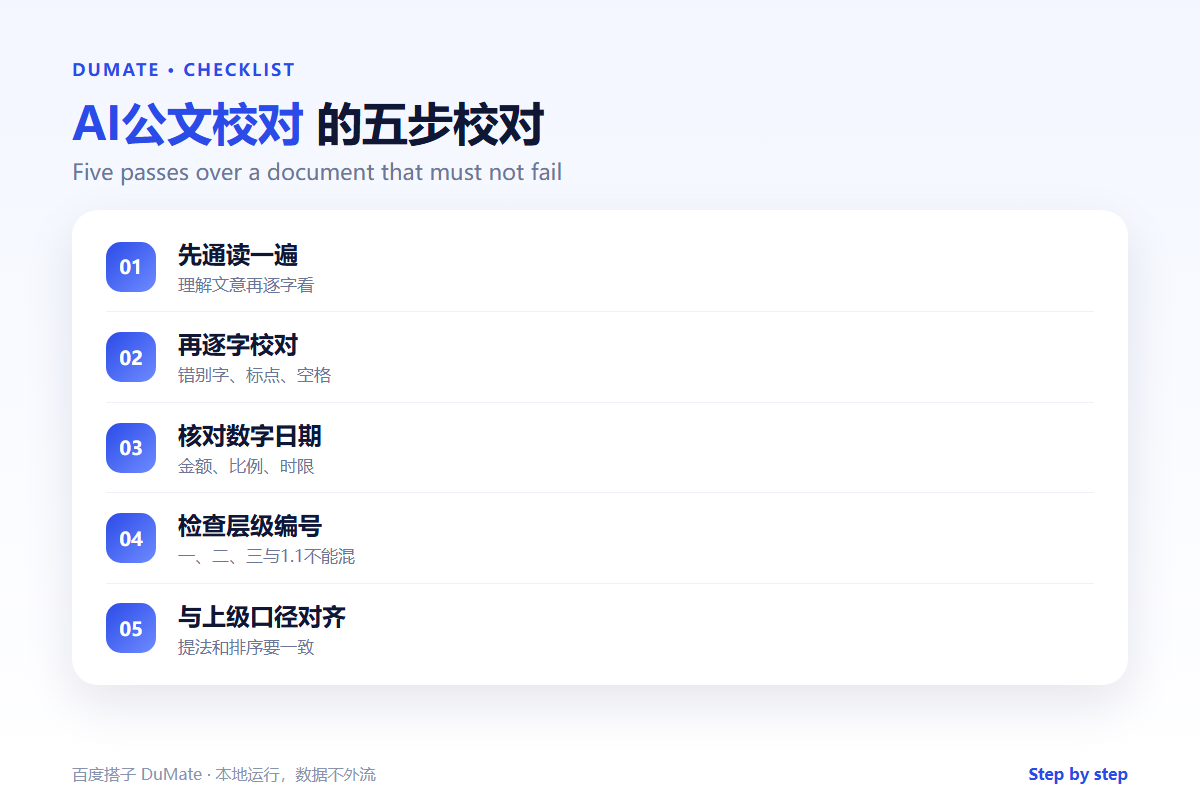
A Proofreading Checklist
- The purpose and action are clear.
- Punctuation and spacing are consistent.
- Titles and names match the approved list.
- Numbers agree across sections.
- Numbering and hierarchy are correct.
Where AI公文校对 Fails
It fails when it silently changes a proper name to a more common one. It also fails when it normalizes numbering that was intentionally different.
- Auto-correcting names.
- Missing cross-references.
- Ignoring the attachment list.
- Changing quoted wording.
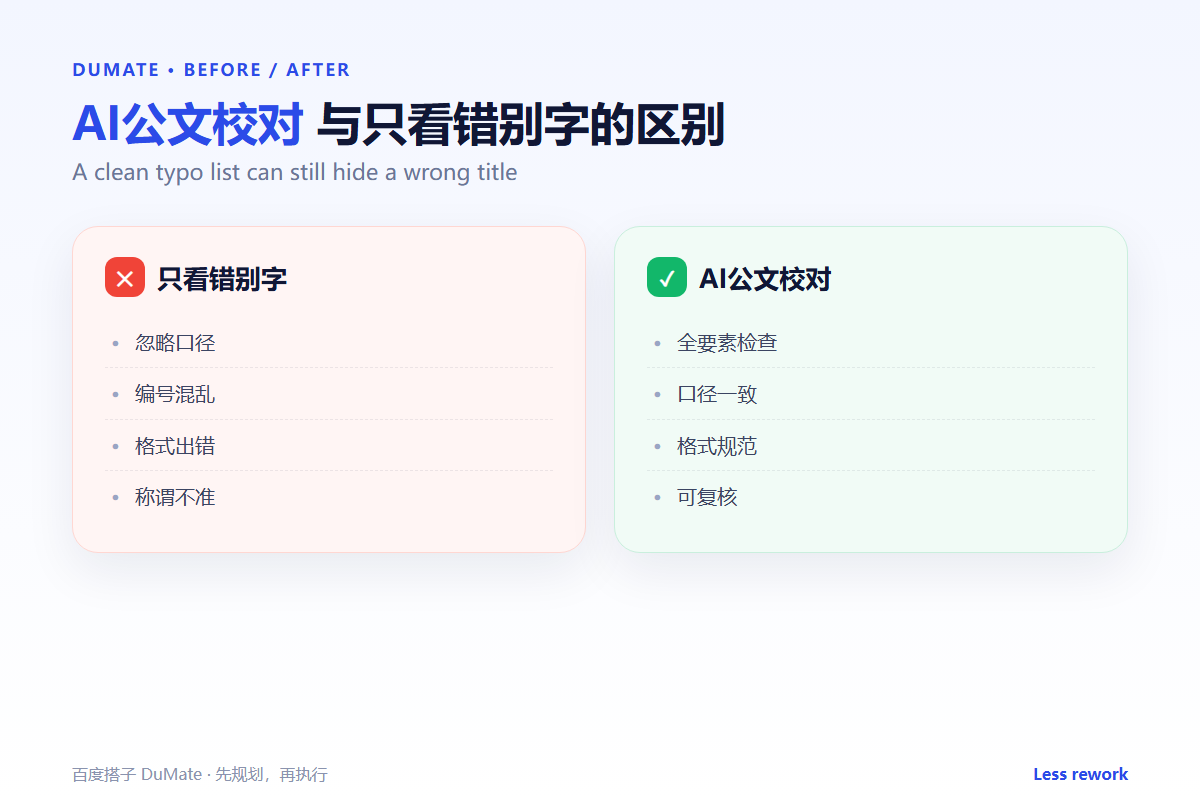
Before and After
Before, a document passed a spelling check and was sent with a deputy director’s title wrong and a date that contradicted the attachment. After, AI公文校对 used a five-pass checklist, and both errors were caught before circulation.
Proofreading is not about finding every comma. It is about protecting the document’s credibility.
Used consistently, AI公文校对 becomes part of the normal review routine rather than a separate project.
A final check with AI公文校对 takes a minute and catches the errors that are easiest to miss.
The same AI公文校对 routine works for small tasks and large ones, which is why teams keep using it.
A Four-Week Rollout
The first week with AI公文校对 should be a small pilot, not a team-wide launch. Choose one recurring task with a clear output and run it end to end. Keep the sample small enough to check by hand. The point is to see where AI公文校对 saves time and where it creates review work.
During the pilot, keep a short log of inputs, outputs, and corrections. Record the time spent before and after. AI公文校对 feels faster even when it is not, so the log matters. At the end of the week, review the log with one colleague and decide whether to continue, change the input, or stop.
In week two, write a one-page standard for input and output. Include what must be checked and who approves the result. AI公文校对 works better when the standard is visible to everyone. In week three, add permissions and a review step. In week four, compare the results and write a short guide. That guide is what makes AI公文校对 survive after the first month.
Keep the pilot narrow. A broad rollout hides which step failed, and a narrow one shows exactly where the workflow needs help. Expand only after the narrow case is stable.
Keep the first month simple. One task, one owner, and one weekly review are enough to prove the workflow before it spreads across the team.
Write down what changed after each run. A short note is easier to trust than a memory, and it makes the next improvement obvious.
Review the output before it leaves your desk. A two-minute check catches most of the errors that would otherwise come back as questions.
Keep one example of a good result. New team members learn faster from a concrete reference than from a long explanation.
The first version does not need to be perfect. It needs to be complete enough to review, so the team can see the gaps and fix them in the next round.
Write the review notes in the same place as the work. Notes stored somewhere else are rarely read when the next decision arrives.
FAQ
Should I use a tool or a person?
Both. The tool is fast and consistent; the person understands context and intent.
What should be checked against the source?
Quotations, figures, titles, and dates. Everything that carries an obligation.
How many passes are enough?
Three for routine documents, five for documents that go outside the organization.
延伸阅读
For drafting, see AI公文写作. Typo checking is covered in AI错别字检查. For wording, read AI写作助手. Keep approved names in an AI知识库. Access rules are in AI权限管理. External references: NIST AI Risk Management Framework and ISO/IEC 42001.
评论
还没有评论,来说两句吧。以下为本文的引用通告: